Showing posts with label kinetic energy. Show all posts

Sunday, November 5, 2017

Chapter 6.2 - The Kelvin scale for measuring Temperature

In the previous section we saw the details about the Celsius scale and the Fahrenheit scale to measure temperatures. In this section we will see another scale.

• Recall the rod in fig.6.4 on which various temperatures were marked. 
• Now, a third group of scientists walk upto the rod and add some more details. The new details that they added are shown in magenta color in fig.6.14 below:
Fig.6.14
• We can see that, 273o K is marked at A. Also 373o K is marked at B. What do they mean? 
• Ans: They have used a third scale. It is called the kelvin scale. 
    ♦ In that scale, the heat content corresponding to the freezing point of water is given the value: 273.
    ♦ And the heat content corresponding to the boiling point of water is given the value 373. 
• So this scale is similar to the Celsius scale. because, there are exactly 100 units between freezing point of water and boiling point of water. 
• Because of this similarity in units, we can easily convert from Celsius to kelvin and vice versa. Let us see an example:
• The normal human body temperature is 37o C. Find how much it is in the kelvin scale?
Solution:
1. 37o C is 37 units above zero in the Celsius scale
2. The units in Celsius and Kelvin scales are of the same magnitude. Also, corresponding to zero in the Celsius scale, we have 273 in the kelvin scale.
3. So the required value is 37 units above 273 in the kelvin scale  
4. Thus we have: 37o C = (273 + 37)o K = 310o K

From this problem, we get a general method:
• If C is the given temperature in the Celsius scale, and K is the required temperature in Kelvin scale, we can write:
Eq.6.4:
K = 273 + C
• This equation can be rearranged to obtain C, if we are given K. That is:
Eq.6.5:
C = K - 273

• Before we proceed to the next topic, we have to learn one more detail about the kelvin scale. 
• In the fig.6.14, note the value of 0o K written at the left most end of the rod. It is a new point 'C'.
• According to the Kelvin scale, 0o K is the lowest possible temperature. 
    ♦ At this temperature, the kinetic energy of the molecules become zero. 
    ♦ This temperature is also called the absolute zero. 
• Let us convert this absolute zero into Celsius scale:
1. From Eq.6.5, we have: C = K - 273.
2. The given temperature in K = absolute zero = 0o K
3. Substituting this in (1), we get: C = 0 - 273 = -273o C
• The precise value of absolute zero is -273.15o C
4. So the temperature in Celsius scale, corresponding to absolute zero is -273o C
• We can get a rough idea about 'how cold -273 C is' by considering the following facts:
    ♦ Carbon dioxide becomes solid to form dry ice at -78.5o C
    ♦ Oxygen turns from gaseous state to liquid state at -183o C

• Now let us see 'how much is absolute zero in the Fahrenheit scale':
1. We have: absolute zero = 0o K = -273.15o C
2. All we need to do is: Convert this C into F
We can use Eq.6.2:
F = [(9⁄5)×C  + 32] =
3. Substituting the given value of C, we get:
F = [(9⁄5)×(-273.15)  + 32] = -491.67 + 32 = -459.67o F


We can add these details to fig.6.14 that we saw above. The modified fig.6.15 is shown below:
Fig.6.15


Solved example 6.3
What are the following temperatures in the Celsius scale?
(a) 491.67o F (b) 673 K
Solution:
Part 1:
1. In this problem, we have to convert from Fahrenheit to Celsius. We can use Eq.6.3:
C = (5⁄9)×[F-32]
2. Substituting the given value of F, we get:
C = (5⁄9)×[491.67-32] = (5⁄9)×[459.67] = 255.372o C   
Part 2:
1. In this problem, we have to convert from Kelvin to Celsius. We can use Eq.6.5:
C = K - 273
2. Substituting the given value of K, we get:
C = 673 - 273 = 400o C


In the next section, we will see Specific heat capacity.

PREVIOUS        CONTENTS          NEXT


Copyright©2017 High school Physics lessons. blogspot.in - All Rights Reserved

Saturday, November 4, 2017

Chapter 6 - Heat

In the previous section we completed a discussion on wave motion. In this section we will discuss some basic details about Heat.
• Matter exists mainly in three states: Solids, Liquids and Gases. 
• The building blocks of all material are molecules. It is interesting to know how these molecules are placed inside the materials. Let us analyse:
1. In solids, the molecules are rigidly held in positions. That means they cannot move from their positions. 
• This is because, the inter molecular attractive forces are very high in solids. 
• Also, the molecules in solids are very closely packed. That means, the distances between molecules in solids are very small. 
2. In liquids, the molecules are not rigidly held in positions. So they can move from their positions. 
• This is because, the inter molecular attractive forces are low in liquids. 
• Also, the molecules in liquids are not very closely packed. The distances between molecules in liquids are greater than that in solids. 
3. In gases also, the molecules are not rigidly held in positions. So they can move from their positions.
• This is because, the inter molecular attractive forces are low in gases. These forces are so low that, the molecules of gases have greater freedom than the molecules of liquids
• Also, the molecules in gases are not very closely packed. The distances between molecules in gases are greater than that in solids and liquids.

■ The molecules of all matter are always in a state of motion.
• Even the molecules of solids are always in a state of motion. 
• Hence all the molecules possess kinetic energy. 
• Let us consider the three states of water. 
1. In the solid state, it is ice. When the water becomes ice, it is a solid. 
• The molecules of ice are rigidly held in position. The freedom of motion is very low. 
• Even in such a condition, they possess kinetic energy. But this kinetic energy will be very low.
2. In the liquid state, water molecules have a greater freedom of motion. 
• So they possess a little more kinetic energy than in solids
3. In the gaseous state, water is water vapour. The molecules have very large freedom of motion. 
• So the kinetic energy will also be very large.

Let us do an experiment to understand the relation between heat and kinetic energy. The steps are given below:
1. Wrap some potassium permanganate and a small piece of stone using plastic coated paper. 
• Make one more such packet. 
2. Put small holes in both the packets using a needle. 
3. Take some hot water in one beaker and cold water in another beaker.
• The quatities of water must be the same in both the beakers. 
4. Put the prepared packets into the beakers at the same time. 
• We can see that the colour of the potassium permanganate spreads in the hot water quickly. See fig.6.1 below:
Fig.6.1
• How can we explain this observation?
The explanation can be given in steps: 
(i) In hot water, the molecules have greater kinetic energy. So they have greater speeds. 
(ii) Because of the greater speeds that they possess, they can reach greater distances in lesser time. 
(iii) So the molecules of the potassium permanganate spreads out to a larger area with in a short span of time. 
4. This is not possible in cold water. In it, the molecules will travel only slowly. 
Conclusion:

When any substance is heated, the speed of motion of molecules in that substance increases. So kinetic energy of those molecules increases.

Another experiment:

1. Take equal amount of water in two beakers. 
2. Heat one of them for some time. 
3. Now touch the water in both beakers. 
• We can see that water in the heated beaker is at a higher temperature. 
• This is because, the water in the heated beaker absorbed heat energy. 
• When heat energy is absorbed, the kinetic energy of the water molecules increases 

• But all the molecules in the hot water beaker will not be having the same kinetic energy.
    ♦ The molecules which are near the source of heat (the spirit lamp or burner) will be having a greater kinetic energy
    ♦ The molecules which are away from the source of heat will be having a lesser kinetic energy
    ♦ The molecules which are at an intermediate distance from the source of heat will be having an intermediate kinetic energy.
• Thus comes the need for mentioning an 'average kinetic energy' 

So we will see Total kinetic energy and Average kinetic energy:
1. Let the total kinetic energy of the cold water be k1
2. Let the total kinetic energy of the hot water be k2
3. It is clear that k2 is greater than k1
4. The number of molecules in both the beakers are the same. Because we took equal amount of water in both beakers. Let this number be 'n'. 
5. So average kinetic energy in cold water = k1⁄n
• average kinetic energy in hot water = k2⁄n
6. The denominators are the same. And k2 > k1. So we get:
■ Average kinetic energy in hot water is greater than average kinetic energy in cold water.

• For measuring the 'quantity of heat', we need a physical quantity. The physical quantity that we use for this purpose is temperature.
• 'Temperature' is related to 'quantity of heat' in the same way as 'volume' is related to 'quantity of space'. 
• Let us see an example:
1. Consider the box shown in fig.6.2(a) below:
Fig.6.2
2. A group of students walk upto the box and take it's measurements. They note down the measurements and do some calculations. 
3. Then they write down the result: Volume of the box is 0.0394 cubic meter.
4. Now, another group of students from another part of the world, walk upto the box and take it's measurements. They note down the measurements and do some calculations. 
5. Then they write down the result: Volume of the box is 1.39 cubic feet.
6. The volume of the box remains the same. 
• The two different values (0.0394 and 1.39) are obtained because they used two different system of units. 
    ♦ The first group of used the SI system of units. 
    ♦ The second group used the Imperial system.
7. What ever system is used, the 'quantity of space' or the 'volume' occupied by the box does not change. 

1. Now consider the sphere shown in fig.6.2(b).
2. A group of scientists walk upto the sphere and measure it's temperature.
3. Then they write down the result: The temperature is 37 degrees Celsius.
4. Another group of scientists from another part of the world walk up to the sphere and measure it's temperature. 
5. Then they write down the result: The temperature of the sphere is 98.6 degrees Fahrenheit.
6. The 'quantity of heat energy' possessed by the sphere is the same. 
• The two different values (37 and 98.6) are obtained because they used two different system of units. 
    ♦ The first group of used the Celsius scale. The '37 degrees Celsius' can be abbreviated as: 37o C
    ♦ The second group used the Fahrenheit scale. The '98.6 degrees Fahrenheit' can be abbreviated as: 98.6o F
7. What ever system is used, the 'quantity of heat energy' possessed by the sphere does not change. 

■ But we have to learn the relation ship between the two systems: 'Degrees Celsius' and 'Degrees Fahrenheit'. Let us analyse:
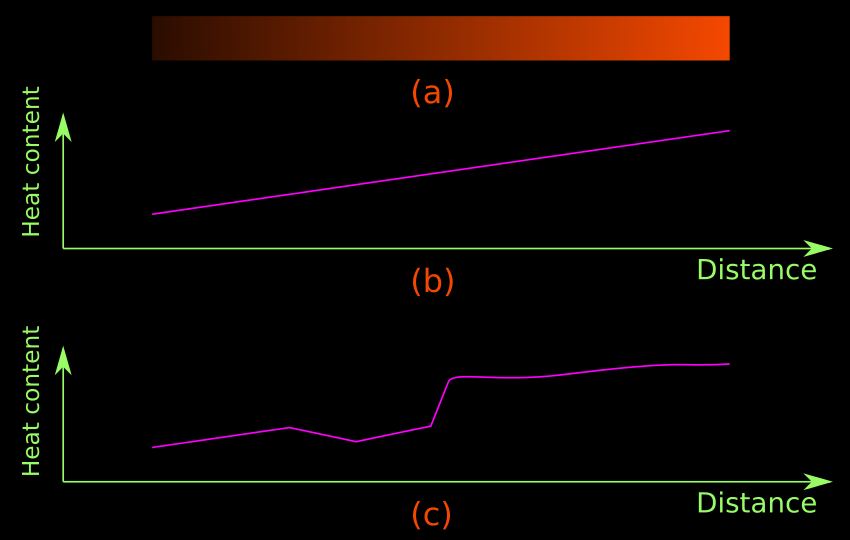
1. Consider a solid rod shown in red colour in fig.6.3(a) below:
Fig.6.3
• It is made of a suitable material so that, it can withstand extreme temperatures. 
• That is., it can withstand 'very low temperatures' and also 'very high temperatures'. 
2. The rod in fig.6.3(a) is experiencing such extremes. 
• It's left end is at a very low temperature. 
• As we move to the right, the temperature increases gradually. 
• The 'increases in temperature' is uniform. So if we draw a graph, it will be a single straight line. This is shown in fig.6.3(b). 
• The graph shown in fig.(c) shows a non uniform increase. 
3. For our present discussion, the 'increase in temperature' is uniform. 
4. If we consider any particle along the length of the rod, that particle will have more heat than the particles on it's left side.
■ Now we will make a closer study on the rod. 
5. A group of scientists walk upto the rod. They measure the temperatures at various points along the length of the rod. 
6. Then they mark a point 'A' on the rod. Also at that point, they write '0o C'. It is shown in fig.6.4 below:
Fig.6.4
7. The onlookers asked them: 'Why mark 0o C at that point?' 
• The scientists replied: 'Because the heat content at that point is 'just low enough' to make water freeze'. 
    ♦ 'Just low enough' means that if we place water any where to the right of 'A', it will not freeze.
    ♦ The word 'just' is used on many occasions in physics. It indicates a 'border'.
8. The temperature at which water freezes is a 'good base mark'. We can relate all other temperatures to it. 
• Now the reader may wonder: The point 'A' is not at the exact left end of the rod. It is at some distance away from the left end. 
• That means the particles to the left of 'A' are colder than the freezing point of water. Are such colder temperatures possible?
• Of course they are possible. For example, 'dry ice' is colder than 'ice made from water'.
9. Now another group of scientists from another part of the world, walk upto the rod. They measure the temperatures at various points along the length of the rod. 
10. Then at the same point 'A', they write '32o F'. This is shown in fig.6.5 below:
Fig.6.5
11. The onlookers asked the same question as before: 'Why mark 32o F at that point?' 
• The reply was also the same as before: 'Because the heat content at that point is 'just low enough' to make water freeze'.
12. The 'quantity of heat at point A is the same. But the two groups of scientists used different systems of measurements. That is why we have two different values: 0 and 32 at the point A 
• The first group used the Celsius scale. 
• The second group used the Fahrenheit scale.

The scientists continued their work. We will see it in the next section.

PREVIOUS        CONTENTS          NEXT


Copyright©2017 High school Physics lessons. blogspot.in - All Rights Reserved

Saturday, April 22, 2017

Chapter 4.3 - Law of Conservation of Energy

In the previous section we saw basic details about potential energy. In this section we will see the Law of conservation of Energy.

In our day to day life, we see different sources of energy. Let us see some examples:
Example 1: An ordinary torch cell is a source of energy. In it, energy is stored in the form of chemical energy. But we cannot use this chemical energy directly. In the torch, the chemical energy is first converted into electrical energy. This electrical energy is then converted into light energy.

Example 2: In a motor car, we fill petrol. This petrol contains lot of chemical energy. In the car’s engine, this petrol burns, and causes the engine parts to move. The movement of engine parts is transmitted to the wheels of the car. Thus the car moves forward. So the chemical energy in petrol gets converted into kinetic energy of the car.

Example 3: The sun provides heat energy. This energy causes the water in oceans and lakes to evoporate. The vapours thus formed will merge together to form clouds. When the clouds cool, they come down as rain. This rain is collected in reservoirs. The reservoirs are constructed at higher levels. So the water in them have high potential energy. This water flows down through special pipes with great force and turn the turbines of generators, thus producing electricity. So we find that heat energy of the sun is first converted into potential energy of water in the reservoirs. This potential energy is then converted into electrical energy. We can say that, the heat energy from the sun got finally converted into electrical energy

Example 4: The food that we eat contains a lot of chemical energy. We get energy for our daily activities from this chemical energy. When we climb the stairs of a building and reach an upper floor, our muscles have to do a lot of work. Much energy that we received from the food will be used up when we climb steps. But that energy will not be wasted because, when we reach a higher level, our potential energy increases. We can say that the chemical energy from the food, got finally converted into potential energy.

• Thus we see a lot of energy conversions taking place around us. 
• But whenever such conversions take place, a peculiar phenomenon occurs. 
• That is., the total energy remains unchanged. This is called the Law of conservation of energy. 
• Let us see how this law applies to the above examples:

Example 1. In the case of torch cells, the chemical energy got converted into light energy. 
• According to the law, total energy derived from the cell is equal to the total light energy produced.
• But such a perfect conversion is not possible. Because, a portion of the chemical energy is lost as heat energy.
• But if we calculate the sum, we will find that the law is valid. That is.,
• Chemical energy derived from the cell = 
[Light energy] + [Heat energy wasted]

Example 2: Chemical energy derived from the petrol 
= [Kinetic energy of the car] + [Heat energy wasted in the engines] + [Energy lost to overcome friction between tyres and road when the car moves] + [Energy lost to overcome air resistance encountered when the car moves]

Example 3: Heat energy derived from the sun =
[Electrical energy produced in the generators] + [Heat energy wasted in the generators and turbines] + [Energy lost to overcome friction between water and inside surface of pipes] + [Potential energy lost due to leakage in pipes]

Example 4: Chemical energy derived from the food =
[Potential energy of the person] + [Heat energy wasted in the body]

• So we see that the converted energy consists of various components. We will learn about those components in detail, in higher classes. At present, all we need to know is that, when we add those components, we will find that the total energy after conversion remains the same. 
• In other words, the total energy before conversion is equal to the total energy after conversion.

The law of conservation of energy states that:
■ Energy can only be converted from one form to another; it can neither be created or destroyed.

In this chapter, we learned about kinetic energy and potential energy in some detail. So we will learn the details about the conversion between them. We will learn it with the help of an example.

1. An object A of mass of 25 kg is at rest. It is situated at a height of 6 m above the ground. Let this state of rest be 'Stage 0'. It is shown in fig.4.5 below:
This example demonstrates the law of conservation of energy.
Fig.4.5
• Let the acceleration due to gravity be taken as 10 m s-2.
• At this stage, it’s potential energy Ep is mgh = 25 × 10 × 6 =  1500 J
• At this stage, it’s kinetic energy Ek = zero. Because it has no velocity. It is at rest.
• So we can say that, at stage 0, total energy, Ep + Ek = 1500 + 0 = 1500 J 

2. It is then allowed to fall freely. Consider the 'stage 1' when it travels 1 m from start . 
• That is., At stage 1, the object is at a height of 5 m from the ground.
• At this stage, it’s potential energy = mgh = 25 × 10 × 5 = 1250 J
    ♦ So loss of potential energy = Ep at stage 0 - Ep at stage 1 = 1500 - 1250 = 250 J 
• At this stage, we want to know it’s kinetic energy. 
• For that, we want it’s velocity at this stage. We know that, when an object is allowed to fall freely, it accelerates towards the earth, and so it’s velocity increases. Using the third equation of motion, we can calculate the velocity at any stage:
• v2 = u2 + 2as ⇒ v2 = 0 + 2gs ⇒ v2 = 0 + 2×10×1 ⇒ v2 = 20 [u = 0 because, the object falls from rest]
• So the kinetic energy, Ek = 1⁄2 × mv2 = 1⁄2 × 25 × v2 = 1⁄2 × 25 × 20 = 250 J
    ♦ So gain in kinetic energy = Ek at stage 1 - Ek at stage 0 = 250 - 0 = 250 J 
• Also we can say that, at stage 1, total energy, Ep + Ek = 1250 + 250 = 1500 J 

3. Consider the stage 2 when it travels 2 m from start . 
• That is., At stage 2, the object is at a height of 4 m from the ground.
• At this stage, it’s potential energy = mgh = 25 × 10 × 4 = 1000 J
    ♦ So loss of potential energy = Ep at stage 0 - Ep at stage 2 = 1500 - 1000 = 500 J 
• At this stage, we want to know it’s kinetic energy. 
• For that, we want it’s velocity at this stage. As before, using the third equation of motion, we can calculate the velocity:
• v2 = u2 + 2as ⇒ v2 = 0 + 2gs ⇒ v2 = 0 + 2×10×2 ⇒ v2 = 40 [Note that in this problem, we do not need to calculate the square root to find the actual 'v'. Because, we will be using 'v2' in the next step]  
• So the kinetic energy, Ek = 1⁄2 × mv2 = 1⁄2 × 25 × v2 = 1⁄2 × 25 × 40 = 500 J
    ♦ So gain in kinetic energy = Ek at stage 2 - Ek at stage 0 = 500 - 0 = 500 J 
• Also we can say that, at stage 2, total energy, Ep + Ek = 1000 + 500 = 1500 J 

4. Consider the stage 3 when it travels 3 m from start . 
• That is., at stage 3, the object is at a height of 3 m from the ground.
• At this stage, it’s potential energy = mgh = 25 × 10 × 3 = 750 J
    ♦ So loss of potential energy = Ep at stage 0 - Ep at stage 3 = 1500 - 750 = 750 J 
• At this stage, we want to know it’s kinetic energy. 
• For that, we want it’s velocity at this stage. As before, using the third equation of motion, we can calculate the velocity:
• v2 = u2 + 2as ⇒ v2 = 0 + 2gs ⇒ v2 = 0 + 2×10×3 ⇒ v2 = 60 
• So the kinetic energy, Ek = 1⁄2 × mv2 = 1⁄2 × 25 × v2 = 1⁄2 × 25 × 60 = 750 J
    ♦ So gain in kinetic energy = Ek at stage 3 - Ek at stage 0 = 750 - 0 = 750 J 
• Also we can say that, at stage 3, total energy, Ep + Ek = 750 + 750 = 1500 J 

5. Consider the stage 4 when it travels 4 m from start . 
• That is., at stage 4, the object is at a height of 2 m from the ground.
• At this stage, it’s potential energy = mgh = 25 × 10 × 2 = 500 J
    ♦ So loss of potential energy = Ep at stage 0 - Ep at stage 4 = 1500 - 500 = 1000 J 
• At this stage, we want to know it’s kinetic energy. 
• For that, we want it’s velocity at this stage. As before, using the third equation of motion, we can calculate the velocity:
• v2 = u2 + 2as ⇒ v2 = 0 + 2gs ⇒ v2 = 0 + 2×10×4 ⇒ v2 = 80 
• So the kinetic energy, Ek = 1⁄2 × mv2 = 1⁄2 × 25 × v2 = 1⁄2 × 25 × 80 = 1000 J
    ♦ So gain in kinetic energy = Ek at stage 4 - Ek at stage 0 = 1000 - 0 = 1000 J 
• Also we can say that, at stage 4, total energy, Ep + Ek = 500 + 1000 = 1500 J 

6. Consider the stage 5 when it travels 5 m from start . 
• That is., at stage 5, the object is at a height of 1 m from the ground.
• At this stage, it’s potential energy = mgh = 25 × 10 × 1 = 250 J
    ♦ So loss of potential energy = Ep at stage 0 - Ep at stage 5 = 1500 - 250 = 1250 J 
• At this stage, we want to know it’s kinetic energy. 
• For that, we want it’s velocity at this stage. As before, using the third equation of motion, we can calculate the velocity:
• v2 = u2 + 2as ⇒ v2 = 0 + 2gs ⇒ v2 = 0 + 2×10×5 ⇒ v2 = 100 
• So the kinetic energy, Ek = 1⁄2 × mv2 = 1⁄2 × 25 × v2 = 1⁄2 × 25 × 100 = 1250 J
    ♦ So gain in kinetic energy = Ek at stage 5 - Ek at stage 0 = 1250 - 0 = 1250 J 
• Also we can say that, at stage 5, total energy, Ep + Ek = 250 + 1250 = 1500 J

7. Consider the stage 6 when it travels 6 m from start . 
• That is., at stage 6, the object is at a height of 0 m from the ground.
    ♦ That means the object has reached the ground. When it reaches the ground, it's velocity will be zero. So we will consider the instant when it just reaches the ground. At this stage, the velocity will be the maximum.
• At this stage, it’s potential energy = mgh = 25 × 10 × 0 = 0 J
    ♦ So loss of potential energy = Ep at stage 0 - Ep at stage 6 = 1500 - 0 = 1500 J 
• At this stage, we want to know it’s kinetic energy. 
• For that, we want it’s velocity at this stage. As before, using the third equation of motion, we can calculate the velocity:
• v2 = u2 + 2as ⇒ v2 = 0 + 2gs ⇒ v2 = 0 + 2×10×6 ⇒ v2 = 120 
• So the kinetic energy, Ek = 1⁄2 × mv2 = 1⁄2 × 25 × v2 = 1⁄2 × 25 × 120 = 1500 J
    ♦ So gain in kinetic energy = Ek at stage 6 - Ek at stage 0 = 1500 - 0 = 1500 J 
• Also we can say that, at stage 6, total energy, Ep + Ek = 0 + 1500 = 1500 J


We can write the above results in a tabular form as shown below:
From the above table, we can note the following points:
• At any stage, the loss of potential energy is equal to the gain in kinetic energy
• That is., what ever potential energy is lost, is gained by the kinetic energy
• So, there is a continuous transformation of energy from one form (potential) to another (kinetic)
• The total energy, that is., the sum Ep + Ek is always a constant
■ So this is an excellent example to prove the Law of conservation of energy

Now we will see a solved example
Solved example 4.8
An object of mass 40 kg is raised to a height of 5 m above the ground. What is its potential energy? If the object is allowed to fall, find its kinetic energy when it is half-way down. Take g = 10 m s-2
Solution:
Mass m = 40 kg, Height h = 5 m
Part (i): Ep = mgh = 40 × 10 × 5 = 2000 J
Part (ii): We know that, when an object is allowed to fall freely, it accelerates towards the earth, and so it’s velocity increases. Using the third equation of motion, we can calculate the velocity at any stage. We want the velocity when it is 2.5 m from the ground.
• v2 = u2 + 2as ⇒ v2 = 0 + 2gs ⇒ v2 = 0 + 2×10×2.5 ⇒ v2 = 50 [u = 0 because, the object falls from rest] 
• So the kinetic energy, Ek = 1⁄2 × mv2 = 1⁄2 × 40 × v2 = 1⁄2 × 40 × 50 = 1000 J

In the next section, we will see Power. 

PREVIOUS      CONTENTS       NEXT

                        Copyright©2017 High school Physics lessons. blogspot.in - All Rights Reserved

Friday, April 21, 2017

Chapter 4.2 - Potential Energy

In the previous section we saw basic details about kinetic energy. In this section we will see potential energy.

■ Take a rubber band. Hold it's one end and pull the other end. 
• The band stretches. In this stretched position, the band will try to pull our fingers at the two ends. We can feel it because, we have to apply force to keep the band in a stretched position. So it is clear that the band is applying a pulling force. 
• From where did it get the energy to apply this force?
• We know that a rubber band which is not stretched, will not be able to apply any force.
• So it is clear that, the 'process of stretching' gave it some energy. The energy that we applied to stretch the rubber band, got stored in it. It will be stored in it until it regains it's original shape.
■ Similar is the case of bow and arrow. When the string of the arrow is tightened, the bow bends and is stretched. The energy used to stretch the bow, gets stored in it. 
• When the arrow is placed in the bow and pulled back wards, the bow bends further and more energy gets stored. 
• When the arrow is released, the bow regains it's original position. When this happens, the stored energy is released. This energy is converted into kinetic energy of the arrow and so the arrow moves forward.
■ Consider the stone raised to a height above ground. It possess some energy. It can now do some work, like driving a nail into a wooden piece. 
• It acquired energy because some work was done to raise it to higher position. 
• A stone at ground level will not be able to do work. 

■ In the above three cases, the objects rubber band, bow and stone acquired energy because some work was done on them. 
■ The work done got stored in them as potential energy. 

We have to note some peculiarities of potential energy:
• The 'work done on an object' is stored as potential energy.
• But we saw that kinetic energy is also equal to the 'work done on the object'. 
■ So what is the difference?
• In kinetic energy, the work done causes the object to move continuously with a certain velocity
• But in potential energy, there is no continuous movement for the object. There is only 'change in configuration' or 'change in position'
    ♦ In the case of rubber band, the band changed to a stretched configuration
    ♦ In the case of bow, it changed to a stretched configuration
    ♦ In the case of stone, it's position changed from ground level to a higher level
■ The potential energy possessed by the object is the energy present in it by virtue of its position or configuration.

Gravitational potential energy

We have seen that, when an object is raised to a height, potential energy gets stored in that object. Let us calculate how much joules of energy is stored in this way:
1. Consider an object of mass m. We have seen that it will have a weight W = mg. Where g is the acceleration due to gravity. (Details here)
The earth is pulling this object towards it's centre. The force of this pull is mg newton. 
2. So we have to apply an equal and opposite force to raise the object above the ground. That is., we must apply a force of mg in the upward direction. 
3. We know that work done = force × displacement. If the object is raised to a height h, the displacement is h. So work done on the object = mgh. 
4. This much work gets stored in the object as potential energy. It is called gravitational potential energy. 
5. So, the gravitational potential energy of an object of mass m situated at a height h is equal to mgh. We can write it in the form of an equation:
Eq.4.2:
Gravitational potential energy Ep = mgh

We have to note two important points while considering gravitational potential energy:
First point:
• Consider 'object A' with mass m, remaining at ground level in fig.4.3 below. It cannot do any work on another object which is at the same ground level.
Fig.4.3
• So, if we take the ground level as our 'zero level' or 'datum level':
    ♦ The object A at height 'h' above datum will have an Ep equal to mgh
    ♦ The object A at the ground level is 'useless' as far as potential energy is concerned
• But, if there is a basement level at a height h1 below the ground level, the object A at ground level is 'not useless'. It can do a work equal to mgh1 on an object at the basement level.
■ So it is important to specify a datum when we use potential energy
Second point:

• Consider fig.4.4 below. In the first case, the object is taken to a height h above the ground level, through a straight line path. This is indicated as 'path 1'.
Fig.4.4
• In the second case, the object is taken through 'path 2' which is a zigzag path. 
• The final position in both cases is 'at a height h above the ground level'. 
• So the final potential energy in both cases will be the same: mgh. 
■ So we can say that, the potential energy depends on the height from the datum level. It does not depend on the path taken to reach the height.

Now we will see some solved examples
Solved example 4.6
Find the energy possessed by an object of mass 12 kg when it is at a height of 4 m above the ground. Given, g = 9.8 m s-2.
Solution:
• Mass of the object = 12 kg
• Height above the ground at which the object is situated = 4 m
• Given g =  9.8 m s-2.
• We have: Ep = mgh = 12 × 9.8 × 4 = 470.4 J

Solved example 4.7
An object of mass 15 kg is at a certain height above the ground. If the potential energy of the object is 900 J, find the height at which the object is with respect to the ground. Given, g = 10 m s-2.
Solution:
• Mass of the object = 15 kg
• Potential energy of the object = 900 J
• Given g =  10 m s-2.
• We have: Ep = mgh ⇒ 900 = 15 × 10 × h ⇒900 = 150h ⇒h = 6 m

In the next section, we will see Law of Conservation of Energy. 

PREVIOUS      CONTENTS       NEXT

                        Copyright©2017 High school Physics lessons. blogspot.in - All Rights Reserved